
Carta de Apoyo para Inmigración en Inglés (Immigration letter of support): modelos y ejemplos en Word y PDF
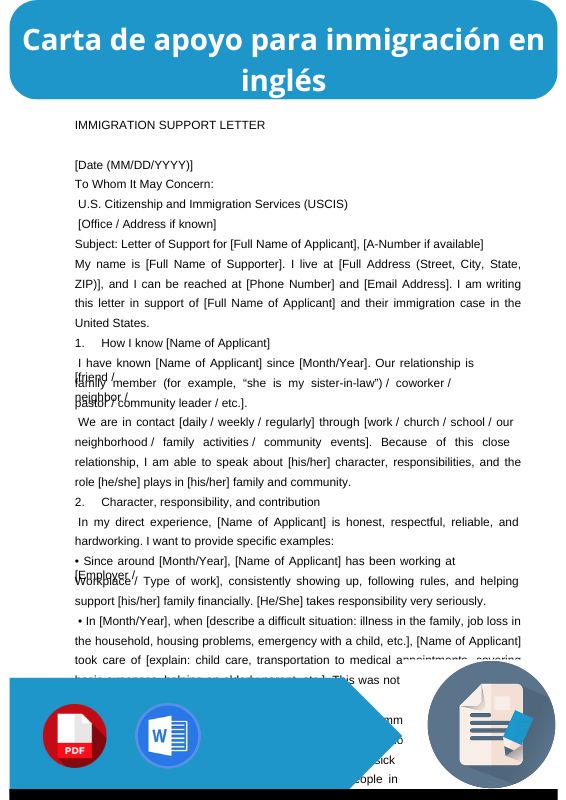
Cuando a alguien le piden “una carta de apoyo para inmigración”, normalmente significa esto: una persona cercana (familiar, pareja, amigo, empleador, líder comunitario, pastor, maestro, etc.) escribe una carta explicando por qué el inmigrante es una persona responsable, necesaria para su familia y con buena conducta moral.
Es una manera de mostrarle al oficial que detrás de ese caso migratorio hay una vida real, no solo papeles.
Este tipo de carta es necesario que esté escrita en inglés, porque va dirigida a inmigración de Estados Unidos. Pero entendemos la realidad: mucha gente habla español, tiene miedo de “escribir mal” y no sabe por dónde empezar.
Por eso te ofrecemos modelos en Word y PDF ya redactados en inglés para que solo rellenes los datos importantes: nombre, relación, ejemplos concretos de buen carácter y el impacto que tendría separarlos de su familia.
¿Quieres una carta como ésta pero escrita en español?
Si buscas una carta de apoyo para inmigración en español aquí tienes un enlace para que la puedas descargar:
Ejemplo de carta de apoyo para fines de inmigración en inglés para llenar y descargar gratis
Este ejemplo está escrito en inglés claro y formal, como se espera en estos trámites, pero con espacios marcados para que pongas tu información sin tener que traducir todo tú mismo.
✉️ Modelo de carta de apoyo para inmigración en inglés para copiar y pegar
[Date (MM/DD/YYYY)]
To Whom It May Concern:
U.S. Citizenship and Immigration Services (USCIS)
[Office / Address if known]
Subject: Letter of Support for [Full Name of Applicant], [A-Number if available]
My name is [Full Name of Supporter]. I live at [Full Address (Street, City, State, ZIP)], and I can be reached at [Phone Number] and [Email Address]. I am writing this letter in support of [Full Name of Applicant] and their immigration case in the United States.
- How I know [Name of Applicant]
I have known [Name of Applicant] since [Month/Year]. Our relationship is [friend / family member (for example, “she is my sister-in-law”) / coworker / neighbor / pastor / community leader / etc.].
We are in contact [daily / weekly / regularly] through [work / church / school / our neighborhood / family activities / community events]. Because of this close relationship, I am able to speak about [his/her] character, responsibilities, and the role [he/she] plays in [his/her] family and community. - Character, responsibility, and contribution
In my direct experience, [Name of Applicant] is honest, respectful, reliable, and hardworking. I want to provide specific examples:
• Since around [Month/Year], [Name of Applicant] has been working at [Employer / Workplace / Type of work], consistently showing up, following rules, and helping support [his/her] family financially. [He/She] takes responsibility very seriously.
• In [Month/Year], when [describe a difficult situation: illness in the family, job loss in the household, housing problems, emergency with a child, etc.], [Name of Applicant] took care of [explain: child care, transportation to medical appointments, covering basic expenses, helping an elderly parent, etc.]. This was not easy, and [he/she] did it without complaining.
• [Name of Applicant] is also active in [church / school / community group / volunteer program] since [Month/Year], helping with [food distribution / youth activities / translation / community events / childcare / visiting sick neighbors / etc.] approximately [__ hours per week / per month]. People in our community know [him/her] as someone dependable and respectful.
• I have never seen [Name of Applicant] behave in a violent, dishonest, or irresponsible way. On the contrary, [he/she] is calm, cooperative, and always tries to resolve problems peacefully.
From what I have personally witnessed, [Name of Applicant] is a positive, stabilizing presence for [his/her] family and for the people around [him/her].
- Impact if [Name of Applicant] could not remain in the United States
I am very worried about what would happen to [Name of Applicant]’s family if [he/she] were not allowed to remain in the United States.
• [Name of Dependent (for example: child, spouse, elderly parent)] depends on [Name of Applicant] for daily care, emotional support, and basic needs such as transportation, school routines, medical appointments, and financial stability.
• Without [Name of Applicant], [his/her] family would face serious hardship. There would be emotional harm, financial stress, and lack of basic support for [children / spouse / elderly parent / disabled relative].
• Our community would also be affected. [Name of Applicant] is someone people turn to for help. Losing [him/her] would not only hurt [his/her] household, but also neighbors, relatives, and our church/school/community group.
In my opinion, [Name of Applicant] is not just important to [his/her] immediate family. [He/She] is important to many of us.
- Respectful request
For all of these reasons, I respectfully ask that you take [Name of Applicant]’s good character, family responsibilities, and positive contributions into account when reviewing this immigration case. I truly believe [he/she] deserves the opportunity to continue [his/her] life in the United States, to take care of [his/her] loved ones, and to remain part of our community. - Verification
Everything I have written here is based on my direct personal knowledge of [Name of Applicant]. I am willing to answer questions or confirm any detail in this letter.
You may contact me at:
Phone: [Phone Number]
Email: [Email Address]
Address: [Full Address]
Declaration
I declare under penalty of perjury under the laws of the United States of America that the information in this letter is true and correct to the best of my knowledge.
Sincerely,
[Signature]
[Full Name of Supporter (printed)]
[Title/Role if relevant (for example: “Supervisor at [Company]”, “Pastor at [Church]”, “Teacher at [School]”, “Community Volunteer Coordinator”)]
[Full Address]
[Phone Number]
[Email Address]
RECOMMENDED ATTACHMENTS (if available)
• A copy of my ID (driver’s license or state ID) to show I am who I say I am.
• Proof of the activities mentioned (for example: church bulletin, school letter, volunteering flyer, photos with dates, note from a teacher or community leader).
• Proof that [Name of Applicant] supports [his/her] family (for example: evidence of work, proof of childcare responsibilities, proof of medical appointments attended with a child or parent).
Descarga aquí nuestra carta de apoyo para fines de inmigración en inglés en el formato que desees
Vas a poder descargar varias versiones del modelo en inglés. Elige el que consideres más adecuado por medio de los enlaces que verás más abajo.
Si la quieres escribir tú mismo desde cero (o quieres entender qué espera leer un oficial), sigue esta estructura:
- Quién eres tú
Empieza la carta identificándote: nombre completo, dirección, teléfono y si quieres tu estatus (por ejemplo: “I am a U.S. citizen and I have known [Name] for six years…”). Poner tu estatus ayuda porque deja claro que tú puedes dar fe de lo que estás diciendo y que estás dispuesto/a a responder preguntas. - A quién estás apoyando
Incluye el nombre completo de la persona inmigrante, cómo la conoces y desde cuándo. Este punto es clave, porque el oficial quiere saber que tú realmente conoces a esa persona en la vida real. - Por qué estás escribiendo esta carta
Di claramente para qué es la carta. Ejemplo: “I am writing this letter in support of [Name] and [his/her] immigration case.” No hace falta usar lenguaje técnico legal; basta con que quede claro que tu intención es apoyar el caso migratorio de esa persona. - Buen carácter y contribución
Aquí es donde tienes que ser específico. Piensa en ejemplos reales que muestren que esa persona:
- Cuida, mantiene o apoya a su familia.
- Trabaja duro y es confiable.
- Ayuda a otras personas sin esperar nada a cambio.
- Actúa con respeto hacia los demás.
Hablar de acciones concretas tiene mucho más peso que decir “es buena persona”. Por ejemplo: “He personally taken care of his mother during her cancer treatment,” o “She is the one who takes her children to school every day and helps them with homework.”
- Consecuencias de separarlo/a de su familia o comunidad
Aquí explicas el daño real que habría si esa persona no pudiera quedarse. Este punto es especialmente importante cuando hay hijos pequeños, personas mayores enfermas o dependencias económicas fuertes. Es válido hablar del impacto emocional y económico. - Cierre y firma
Termina la carta en inglés con algo como: “I declare that the information in this letter is true to the best of my knowledge. Please contact me if you need any additional information.” Después, firma con tu nombre, fecha y un teléfono o correo donde realmente contestes.
Sobre el autor

Javier es gestor administrativo especializado en procesos migratorios y trámites ante organismos públicos. Experto en redactar documentación que cumpla con estándares oficiales.